
Sports
Why Multi-Purpose Court Flooring Is the Smart Choice for Modern Sports Facilities

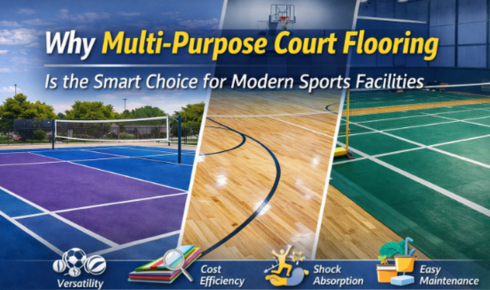
Modern sports facilities are evolving to meet diverse usage demands. Schools, housing societies, academies, and public sports complexes increasingly require spaces that can host multiple sports without compromising safety or performance. This shift has made multi-purpose court flooring a preferred solution for contemporary sports infrastructure.
Rather than building separate courts for each sport, facilities now focus on adaptable surfaces that support various activities while optimizing space, cost, and maintenance. This article explains why multi-purpose court flooring is considered a smart choice for modern sports facilities.
The Growing Need for Multi-Purpose Sports Spaces
Urban development and rising land costs have significantly influenced how sports facilities are designed. In many cases, space constraints make it impractical to construct individual courts for basketball, volleyball, badminton, or recreational games.
Multi-purpose courts address this challenge by offering a single playing area suitable for multiple sports. These courts are designed to accommodate diverse movement patterns, making them ideal for schools, community parks, and indoor sports halls.
The flexibility of multi-purpose court flooring allows facilities to maximize usage throughout the day while serving a broader range of users.
Importance of Multi-Purpose Court Flooring in Performance
The playing surface plays a critical role in how athletes move, stop, and react. Since multi-purpose courts host different sports, the flooring must balance grip, cushioning, and surface speed.
High-quality multi-purpose court flooring provides:
- Controlled traction for different types of footwear
- Consistent surface response across the court
- Comfort during high-impact activities
- Reliable performance for both training and recreational play
This balance ensures that the surface performs well regardless of the sport being played.
Standard Multi-Purpose Court Flooring Dimensions
Planning accurate multi-purpose court flooring dimensions is essential for fair play and usability. While dimensions vary depending on the primary sports intended for the facility, courts are typically designed to accommodate standard layouts for basketball, volleyball, badminton, or futsal.
Clear line markings and proper spacing allow multiple sports to be played safely on the same surface. During the planning phase, designers carefully consider orientation, buffer zones, and run-off areas to ensure smooth transitions between activities.
Correct dimensions help maintain consistency in gameplay while supporting flexible scheduling.
Choosing the Right Multi-Purpose Court Flooring Material
The choice of multi-purpose court flooring material determines durability, safety, and long-term performance. Traditional surfaces such as bare concrete may be economical initially, but they often lack the comfort and grip required for multi-sport use.
Modern facilities increasingly prefer engineered surfaces that offer:
- Uniform texture and traction
- Resistance to surface wear
- Compatibility with both indoor and outdoor environments
- Reduced maintenance requirements
These materials are designed to withstand frequent transitions between sports without compromising surface quality.
Rise of Synthetic Multi-Purpose Court Flooring
One of the most notable trends in sports facility design is the adoption of synthetic multi-purpose court flooring. These systems are engineered to provide consistent performance across various sports while offering improved durability and comfort.
Synthetic surfaces typically feature:
- Seamless or modular construction
- Controlled slip resistance
- Balanced shock absorption
- Long-lasting surface integrity
Because of these characteristics, synthetic flooring has become a practical solution for facilities aiming to support high usage levels.
Role of Flooring in Player Safety
Safety is a primary concern in any sports facility, especially one designed for multiple activities. Different sports involve different movement patterns, including jumping, sprinting, and lateral motion.
Multi-purpose court flooring is designed to reduce slip risks and absorb impact forces more effectively than rigid surfaces. Synthetic systems, when installed correctly, help distribute stress evenly across the surface, supporting safer play for users of all age groups.
This focus on safety makes multi-purpose courts suitable for schools and community environments.
Durability and Long-Term Value
Sports facilities often operate under tight budgets and heavy usage schedules. Flooring durability therefore plays a major role in long-term value.
High-quality multi-purpose court flooring is designed to:
- Withstand continuous foot traffic
- Resist cracking and surface peeling
- Maintain traction and color over time
Durable flooring systems reduce the frequency of repairs and surface replacements, making them a cost-effective choice in the long run.
Maintenance and Operational Efficiency
Ease of maintenance is another reason multi-purpose court flooring is widely adopted. Facilities require surfaces that can be cleaned and maintained without disrupting daily schedules.
Synthetic multi-purpose court flooring systems are generally easy to maintain due to their seamless finish and resistance to dust accumulation. Routine cleaning and periodic inspections are usually sufficient to preserve surface quality, helping facilities operate efficiently.
Multi-Purpose Court Flooring in Modern Court Construction
Successful multi-purpose court flooring court construction involves more than surface selection. Base preparation, leveling, drainage (for outdoor courts), and curing processes all influence long-term performance.
Modern construction practices emphasize precision and consistency to ensure uniform surface behavior. Experienced providers and installers play an important role in achieving reliable outcomes. Industry-focused brands such as Topflooring often highlight the importance of correct installation alongside material quality to ensure dependable performance.
Supporting Community and Institutional Use
Multi-purpose courts are increasingly used as shared community assets. Their adaptability allows facilities to host sports training, recreational play, and community events on the same surface.
By supporting multiple sports and age groups, multi-purpose court flooring helps maximize social value while encouraging physical activity across communities.
Conclusion
Multi-purpose court flooring has become a smart choice for modern sports facilities due to its flexibility, safety, and long-term efficiency. From carefully planned multi-purpose court flooring dimensions to advanced synthetic multi-purpose court flooring materials, today’s solutions are designed to meet the evolving needs of sports infrastructure.
As facilities aim to optimize space, reduce maintenance costs, and support diverse user groups, multi-purpose court flooring continues to play a central role in modern court construction. Thoughtful design and material selection ensure that these courts remain reliable, safe, and adaptable for years to come.







You must be logged in to post a comment Login